2017 ANIMAL BEHAVIOR SOCIETY CHILDREN’S BOOK AWARD WINNER AND FINALISTS STIMULATE YOUNG READERS
Stories and pictures illustrate science in an exciting way. This year the Animal Behavior Society recognized one winner and three finalists through our Outstanding Children’s Book Award program. These books are targeted to children in grades 3-5 (ages 8-11). Inspire a future scientist by giving one of these as a gift or by encouraging your school or public library to acquire these titles.
The Animal Behavior Society will soon be soliciting books for next year’s award. Interested publishers should contact the Book Award Sub-committee Chair, Michelle Solensky, E-mail: [email protected].
Outstanding Children’s Book Award Winner (Reviews from Amazon Books)
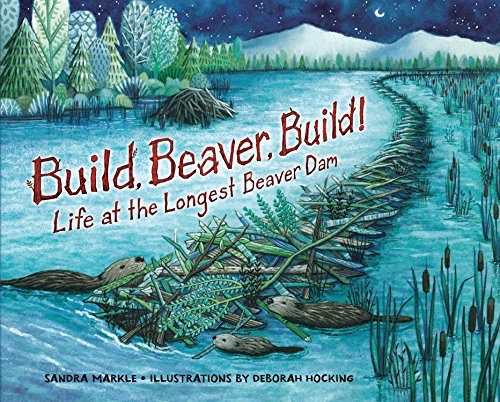 |
The winner of the 2017 Outstanding Children’s Book Award is Build Beaver Build! (Learner Books). The first year of a beaver kit's life is full of new discoveries and dangers. But the most important lesson the kit learns is how to take care of his family's home. The lodge where he lives is protected by a long dam that many beavers have worked to build over the years. As the kit grows up, he helps repair and add to the family dam—and begins to build a life for himself. Set at what is believed to be the world's longest beaver dam, Build, Beaver, Build—by award-winning author Sandra Markle—provides a glimpse of beaver life, seen through the eyes of one young beaver and his family. |
Outstanding Children’s Book Award Finalists
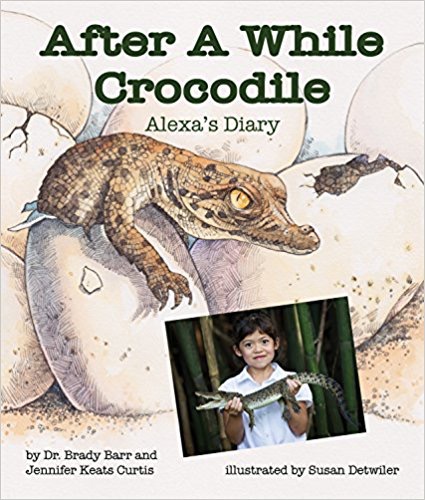
After a While Crocodile: Alexa’s Diary (Arbordale Publishing)
Alexa and the other children at her escuela in Costa Rica have a special project: they are raising American Crocodiles. She names her croc Jefe, which means "boss," because he seems to be in charge of all the other babies. Alexa brings him chicken and frogs to eat, and writes about his progress in her diary. Soon, her little hatchling is as big as a loaf of bread. He has grown into a juvenile and it is time for Alexa to say goodbye and for Jefe to return to the wild.
This nonfiction picture book with a cuddle factor includes a 4-page For Creative Minds section in the back of the book and a 20-page cross-curricular Teaching Activity Guide online. After A While Crocodile is vetted by experts and designed to encourage parental engagement. Its extensive back matter helps teachers with time-saving lesson ideas, provides extensions for science, math, and social studies units, and uses inquiry-based learning to help build critical thinking skills in young readers. The Spanish translation supports ELL and dual-language programs. The enhanced ebook reads aloud in both English and Spanish with word highlighting and audio speed control to promote oral language skills, fluency, pronunciation, text engagement, and reading comprehension. (Dr. Brady Barr, Jennifer Keats Curtis (Authors), and Susan Detweiler (Illustrator).
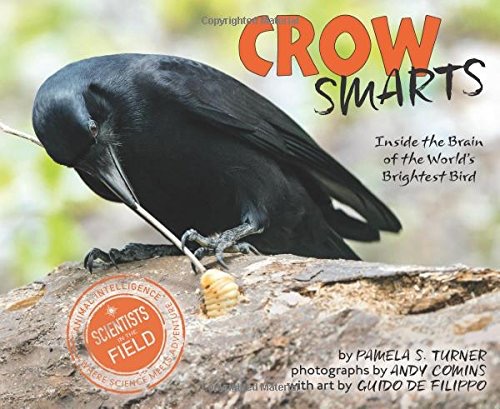
Crow Smarts (Houghton Mifflin Books for Young Readers)
One of the biggest differences between humans and animals is the ability to understand the idea of “If I do X, Y might happen.” New Caledonian crows seem to possess the intelligence to understand this “causal” concept. Why do crows have this ability? What does the crow know and what does it tell us about brain size, the evolution of intelligence, and just who is the smartest creature on the planet? In the latest addition to the Scientists in the Field series, the creators of The Frog Scientist take us to a beautiful Pacific island, where a lively cast of both crows and scientists is waiting to amuse and enlighten us. S. Turner (author), Andy COmins (Photographer).
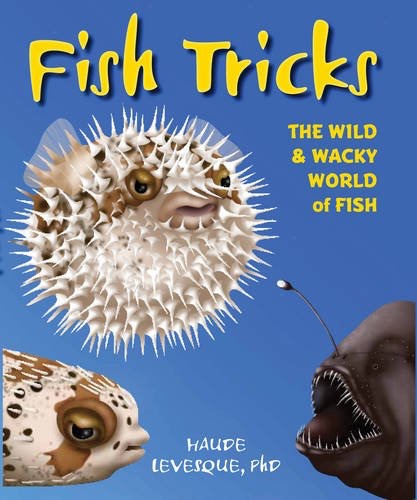
Fish Tricks (Early Light Books)
In Fish Tricks, learn how fish use sound, color, and chemicals to talk to each other and camouflage and toxins to discourage predators. Many have cool body adaptations that help them find food and take care of their young. Meet sea dragons and flatfish that use camouflage to hide from predators. Learn about archerfish that can knock land insects into the water with streams of spit, and anglerfish that grow glow-in-the-dark fishing lines from their heads to lure prey. Laugh at toadfish that make grunting and whistling sounds to attract mates and remora fish with suction cups on their fins that help them stick onto sharks and turtles. Read about fish parents such as cichlids that feed their young with mucus secreted onto their scales and cardinal fish that protect their eggs in their mouths. Under the sea, a whole world of wonder exists that will fascinate the inquisitive mind of every child. Fish Tricks includes a glossary, an index, and fun learn-more adventures. Haude Levesque (Author).