
Stanton (Stan) Braude
By Zuleyma Tang-Martínez & Eileen A. Lacey
Photos credits: ZTM and Washington University

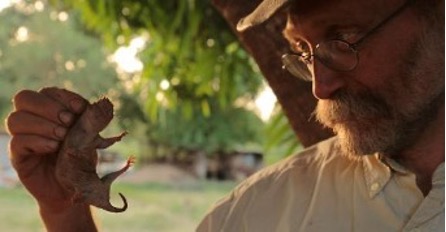
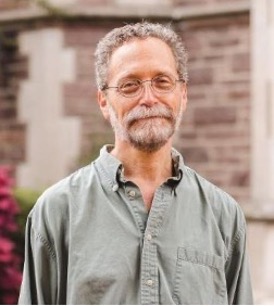
Long-time ABS member Stanton H. (Stan) Braude died in St. Louis, MO, on June 1, 2024, after a very brief and unexpected illness. He passed away at home, surrounded by his family. He was 62 years old.
Stan was born in Chicago, IL, on June 19, 1961. He was fascinated by animals and biology from an early age; his father encouraged Stan’s interests by routinely giving him books about science.
Stan received his undergraduate and graduate degrees from the University of Michigan. It was at Michigan that he met Eileen, when they became office mates there in 1984. Stan completed his Ph.D. on the behavioral biology of naked mole-rats in 1991, working under the supervision of Dr. Richard Alexander. After a short stint in Philadelphia, PA, where he taught human anatomy and physiology, Stan joined Zuleyma’s lab at the University of Missouri-St. Louis, an academic home that allowed him to continue his independent field research on naked mole rats in Kenya. Stan served on the graduate committees for many of Zuleyma’s students and was a generous and dedicated mentor. Later, Stan became an Adjunct Assistant Professor in the Biology Department at UMSL. Stan also lectured part-time in the School of Continuing and Professional Studies at Washington University in St. Louis. In 1997, he began teaching full time at Washington University, eventually being promoted to Professor of the Practice in Biology and Environmental Studies. Stan also was the first Curator of the Washington University Arboretum, which received Morton Arboretum Level II certification under his leadership. In addition to enhancing the scientific standing of the Arboretum, Stan initiated creative public outreach events such as the annual “Love Letters From a Tree” program.
Stan was a frequent, popular, and respected attendee at ABS meetings. He was particularly involved with the ABS Film Festival and the ABS Education Committee. In 2004, he received the ABS Jack Ward Film Award for his film “All the Trappings,” which described his behavioral research in Kenya, with emphasis on methods for humane capture of animals. In 2011, Stan received the ABS Distinguished Teaching Award. Subsequently, Stan was among the members of the Education Committee who advocated for this award to be renamed in honor of Penny Bernstein following her untimely death in 2012. Stan participated in a panel discussion hosted by the ABS Diversity Committee, the purpose of which was to explore the impacts of “invisible disabilities”, including best practices for teaching students with disabilities and identifying ways to make ABS conferences more accessible to colleagues with disabilities. As was typical of Stan, he made sure that the panel ended with concrete recommendations that were transmitted to the ABS Executive Committee. Last but not least, Stan was famous for his late-night ABS Poker Parties. Regular participants received a T-shirt designed by Stan that featured one of C. M. Coolidge’s paintings of dogs playing poker, with the added slogan: “Applied Probability Seminar”.
Stan was a superb teacher and mentor, who loved sharing his fascination and enthusiasm for biology with his many students. He was universally loved by his students for the creativity, originality, and diversity of his courses as well as for his humanity as an instructor. At Washington University, he taught Anatomy and Physiology but was particularly renowned for his undergraduate course on behavior, ecology, and evolution titled “Biology of Dog Breeds”. He would bring his own dogs to class and encouraged invited lecturers to do the same, to allow students to interact with a variety of canines and to illustrate material covered in the class. Stan also developed a course that emphasized the important lessons in biology that can be learned from reading literary masterpieces. His classes on Advanced Wilderness Medicine and Missouri’s Natural Heritage were highly popular, in part because both included field trips that allowed students to camp in different parts of Missouri. Students valued his courses for their scientific content as well as Stan’s personable, friendly approach to teaching. Stan’s excellence as an instructor is evident in the multiple awards that he received. In addition to the ABS teaching award (above), he was twice rewarded for his teaching by the Philadelphia College of Pharmacy and Sciences. In 2001, he was recognized by Washington University with awards for both course innovation and for being an outstanding graduate student mentor. In 2004, the National Association of Biology Teachers named him the “College Biology Teacher of the Year”.
Stan’s educational efforts were not limited to the classroom. He published articles on teaching and pedagogy at both university and K-12 levels that appeared in professional journals such as American Biology Teacher. With Dr. Bobbi Low, a dear friend and mentor at the University of Michigan, Stan co-authored a textbook entitled An Introduction to Methods and Models in Ecology, Evolution and Conservation Biology (Princeton University Press, 2010) that emphasizes active, problem-based learning and provides undergraduates the opportunity to practice the scientific method by generating questions, integrating broad biological principles, and devising methodologies to test their hypotheses. Additionally, Stan co-authored a book entitled The Ethogram and Animal Behavior Research. Designed for grades K-5, this effort includes videos of target animals found at the St. Louis Zoo and was adopted for use in the St. Louis public schools. More generally, Stan was a strong advocate of early STEM education and he actively promoted the use of animal behavior as a mechanism by which K-12 teachers could engage their students in learning about science. As part of his commitment to early science education, Stan worked with schools in St. Louis to coordinate elementary school science fairs and he served on the Clayton, MO School District’s Science Curriculum Committee. Stan’s legacy as a teacher lives on in the many students that he inspired to better understand the marvels of the natural world.
Stan’s research – including the species that he studied – was as diverse as his contributions to science education. He was one of the world’s foremost experts on the behavior, ecology and social evolution of the naked mole rat (Heterocephalus glaber), having conducted decades of field research on this species in eastern Africa. Stan’s distinctive knowledge of the biology of free-living mole-rats led him to question some of the conclusions drawn from studies of captive colonies of these animals, including the presumed rarity of natal dispersal by wild naked mole-rats. Building upon his interest in the social behavior of subterranean rodents, Stan collaborated with Eileen (by then at UC Bekeley) for several years to conduct comparative studies of the group living colonial tuco-tuco (Ctenomys sociabilis) and the syntopic but solitary Patagonian tuco-tuco (C. haigi). While rodent behavior was the primary focus of Stan’s research, he explored the evolutionary history of dogs and the population genetics of rhinoceros (with his friend Dr. Alan Templeton at Washington University) as well as various ecological and behavioral topics involving elephants, dragonflies, and salamanders. Stan’s research was also geographically diverse. Although his work included study sites in Missouri and Argentina, he was particularly drawn to Africa, where he conducted field studies in Kenya, Tanzania, Uganda, Ethiopia, and Djibouti.
Stan was immensely creative and – being relatively free of the constraints imposed by traditional academic roles – he was able to challenge our understanding of multiple aspects of biology. As noted above, Stan questioned several elements of the dogma surrounding naked mole-rats, including the role of inbreeding in promoting group living and the adaptive value of countershading in a hairless mammal that spends the majority of its life underground. Most recently, Stan was studying the occurrence of cancer in these animals, a theme that he was pursuing despite the prevailing belief that this species does not develop this form of illness. Stan pioneered the testosterone and immunoredistribution hypothesis (a paper he published with Zuleyma as coauthor), and, at the time of his death, he was collaborating with Zuleyma on a related paper – a retrospective review questioning the idea that testosterone is immunosuppressive. Stan was also working to establish a link between Vitamin D feedback and persistent irritable bowel syndrome. Stan thought broadly and deeply about biology and, as these snippets suggest, he did not hesitate to explore the unusual. He would often begin his description of an unconventional idea by peering over his glasses, cocking his head to one side, and saying “well, you know …,” after which he would proceed to outline the series of concepts and facts that led him to his latest hypothesis.
Stan was far more than just a biologist. He was an accomplished woodworker who could produce furniture masterpieces from virgin lumber. He loved to design T shirts for various occasions, always with a clever play on words or other form of tongue in cheek humor (e.g., a sketch of a tuco-tuco accompanied by the text “Ctenomys is to love me”). He was an avid home brewer who produced beers and ales, all with funny, biologically-themed names and descriptions. He tapped maple trees on the Washington University campus to make his own maple syrup, which he shared with his students during pancake breakfasts. He also made his own honey and gifted it to friends. He designed traps for various animals, as well as camping gear that he marketed through his BlackHole Ultralight company. He was an inveterate reader who was known for his tendency to leave books at the homes of friends – we all knew that if a random book appeared on our doorstep, it most likely had been left by Stan. He was a baker, a gardener, a forager of wild edibles, and a fisherman (albeit the latter with little success). While Stan loved all animals, he was particularly fond of large dogs and over the years parented a series of Great Pyrenees, Newfoundlands, St. Bernards, and a Bernese Mountain Dogs. Above all, Stan loathed prejudice and injustice and was committed to equality and human rights in all contexts.
Among the things that Stan will be remembered for is his creative frugality – he was “upcycling” unwanted items long before that term became part of our common parlance. Stan’s commitment to reusing discarded items was clearly on display during an early trip to Argentina, when he hopped off the plane in Bariloche carrying a few items of clothing (including the ever-present blue raincoat and bush hat) and a bright orange toilet seat that he had salvaged before leaving home. The latter, which was intended to “make things more comfortable” while camping in Patagonia, must have perplexed and amused local customs officials, who ultimately permitted the entry of this peculiar “import”. The custom live traps that Stan built for the same project are still in use 30 years later, as are the animal holding boxes that he created from used 5-gallon pickle buckets. These resources are contributing to studies of rodent behavior by a new generation of South American biologists who are benefiting from Stan’s creativity and love of tinkering.
During the 2020 pandemic year, Stan scavenged damaged and discarded chairs as well as small tables, and chests, which he then repaired and refinished. He subsequently used them to create attractive and comfortable “study nooks” for students in various hallways in the biology building at Washington University. Poignantly, each study nook was in memory of a Biology professor who had passed away in recent years; he created memorial plaques with the name and information about the deceased which were prominently displayed next to each nook. The last time Zuleyma visited Stan’s office, only a few weeks before his death, he very proudly took her around to show her all the various nooks – describing as he went how he had obtained all the pieces of furniture at no cost - and how important he felt it was to commemorate faculty who had died so the students would know about them and their contributions to the department.. We hope that someone is now constructing such a nook for Stan.
Stan was fiercely loyal and generous to his friends and they, in turn, cherished their time with him. All of us who knew him were stunned and deeply saddened by his unexpected death. As UMSL colleague Dr. Sonya Bahar stated, “it was an honor and a privilege to have known him”. Stan’s untimely passing has left a permanent void in the hearts of many. ABS expresses its deepest condolences to his family. He will be missed for many years to come.
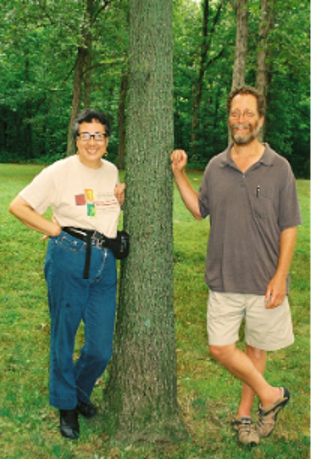
Rest stop during a road trip to an ABS meeting with Zuleyma.
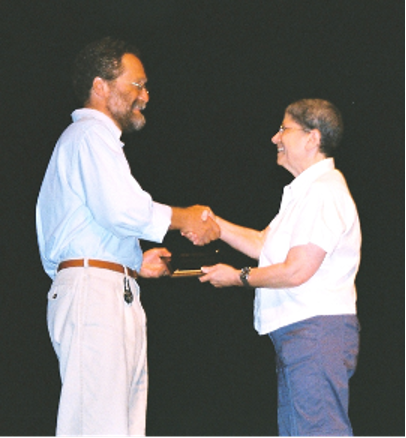
Receiving the ABS Distinguished Teacher Award from Dr. Penny Bernstein (2011).
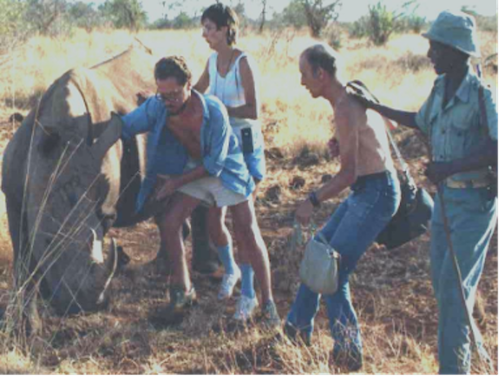
Wrangling a rhinoceros in Africa.