Melissa Kardish and colleagues have recently published a paper in Frontiers in Ecology and Evolution that reports that far fewer of us than should be are conducting experiments with observers that are blind to the hypothesis tested or of treatment condition of a particular sample.
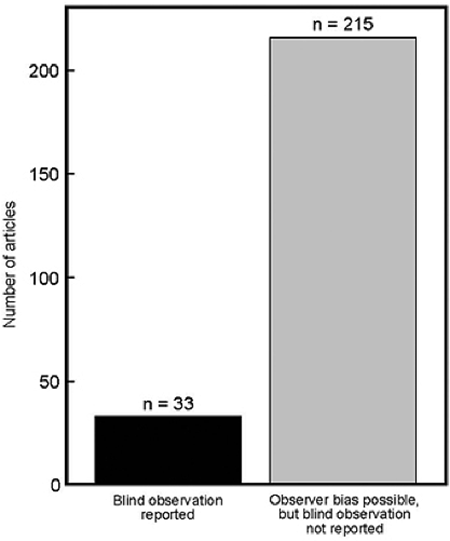
“We surveyed 492 recent studies in the fields of ecology, evolution, and behavior (EEB) to evaluate potential for observer bias and the need for blind experimentation in each study. While 248 articles included experiments that could have been influenced by observer bias, only 13.3% of these articles indicated that experiments were blinded. The use of blind observation therefore was either grossly underreported in the surveyed articles, or many EEB studies were not blinded. We hope that a concerted effort of the field of EEB—including researchers, peer-reviewers, and journal editors—will help promote and institute routine, blind observation as an essential standard that should be practiced by all sciences.”
 Click here to enlarge Click here to enlarge |
Fig 1. Of 492 articles published in January and February in 13 prominent journals covering the fields of ecology, evolution and behavior, 248 articles reported on experiments that had the potential for observer bias. |
|
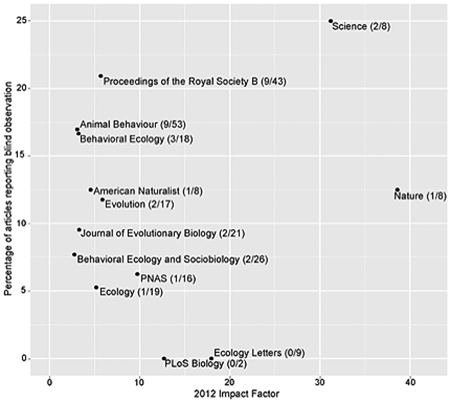
Fig. 2. Of 13 surveyed journals publishing in ecology, evolution and behavior, the percentage of articles reporting the use of blind observation does not differ between journals. |
Melissa R. Kardish, Ulrich G. Mueller, Sabrina Amador-Vargas, Emma I. Dietrich1, Rong Ma1, Brian Barrett, and Chi-Chun Fang. 2015. Blind trust in unblinded observation in Ecology, Evolution, and Behavior. Front. Ecol. Evol., 19 May 2015 | http://dx.doi.org/10.3389/fevo.2015.00051
The whole article can be found at: http://journal.frontiersin.org/article/10.3389/fevo.2015.00051/full
All Frontiers articles are CC-BY, so anyone can use, reuse, share, and adapt the article or parts of it, as long as the authors & the journal are credited.
Michelle Pellissier Scott
(Ex)Executive Editor