WANT TO ADVERTISE A JOB OPPORTUNITY?
Don’t forget that ABS maintains a job postings page on our main website, which you can find here. You can submit a posting here any time (just make sure you log into your account first)!
FOLLOW US ON BLUESKY!
We’re working on building our Bluesky following and hope that we can use this is a way to keep in contact with our members and disseminate important information and opportunities. So give us a follow and tag us whenever you have a cool opportunity or paper you want us to help you advertise! @animbehsociety.bsky.social
ABS IS RECRUITING NEW ASSOCIATE EDITORS
The Animal Behavior Society is recruiting up to five new Associate Editors to serve on the Animal Behavior editorial team for three-year terms beginning January 2026. We strongly encourage nominations and self-nominations of individuals across the breadth of the discipline. To indicate your interest, please send an email to Executive Editor Scott Sakaluk ([email protected]) that provides your institutional affiliation, research interests, and contact information, preferably by October 31.
FUNDING OPPORTUNITIES FOR ABS MEMBERS IN LATIN AMERICA
Awards and funding opportunities provided by the Latin American Affairs Committee this past year included funds to support a variety of efforts on animal behavior in Latin America. Two awards were granted to provide partial support for the Ecophysiology Course held in Tlaxcala (Mexico), and the International Course on Biological Bases of Behavior in Morelia (Mexico). A travel award was awarded to Dr. Ignacio Escalante Meza to participate as an instructor in the OTS 2025 Tropical Ecology course in Costa Rica, work that resulted in a recently published study investigating decision making in antlions:
Farji-Brener, A. G., Víquez, J., Vicuña-Zevallos, W., Villaschi, M., Romero-Ceciliano, M., Navas-Muñoz, D., & Escalante, I. (2025). Using incomplete environmental information compromises the design and efficiency of extended phenotypes. Animal Behaviour, 228, 123310. https://doi.org/10.1016/j.anbehav.2025.123310
A new call for proposals to support Animal Behavior conferences or courses in Latin America is out, and proposals are due October 10th. More information can be found at the LAAC website: https://www.animalbehaviorsociety.org/web/committees-la-affairs.php
OPPORTUNITY TO RESEARCH ANIMAL BEHAVIOR IN A BIODIVERSITY HOTSPOT
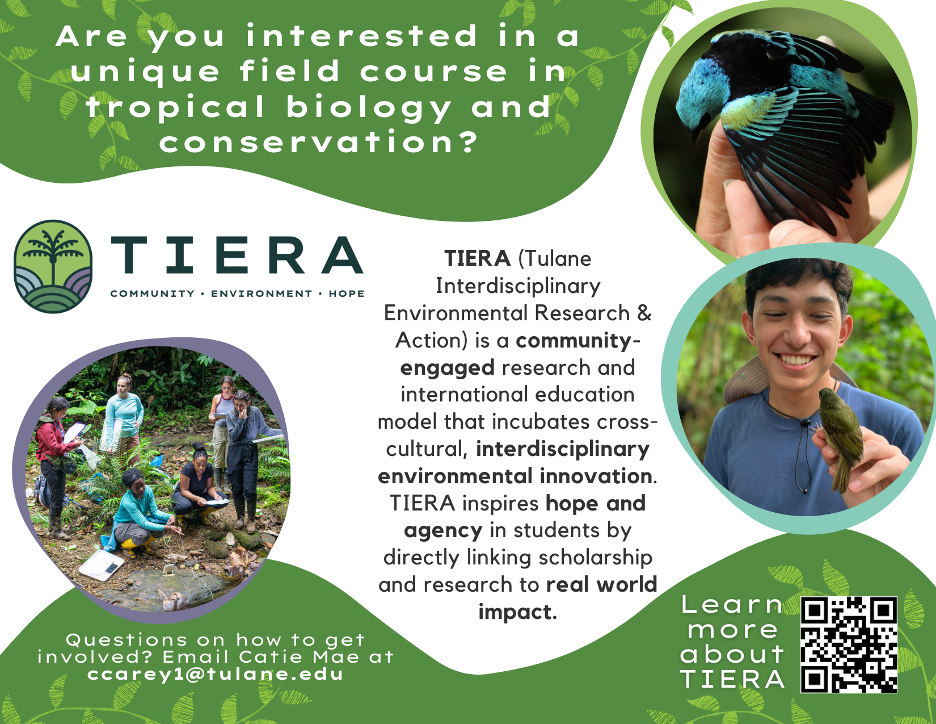
The interdisciplinary TIERA Program is for undergraduate students from all disciplines who are concerned about the environment and looking for a way to make a difference. Our two-week summer field course embeds students in an award-winning, community-led conservation program led by FCAT, an Ecuadorian conservation NGO. Students work closely with highly experienced locals on research projects linked to FCAT’s real world conservation programs, many of which look at animal behavior, such as analyzing bird diversity in reforested areas and studying thermoregulation in amphibians. These linkages between scholarship and conservation outcomes make TIERA a unique experiential learning experience for students who want to want to make a positive impact. Course credit is provided by Tulane University and scholarships are available. Apply here and stay up-to-date with the TIERA Program here.
2026 Field course dates: May 27-June 9 2026 (dates subject to change)
Application Deadline: March 2, 2026
Visit our website for more information: tieraprogram.com
Follow us on Instagram: @tiera_program
Reach out to [email protected] or [email protected] with questions.
INTERNATIONAL RESEARCH PROJECT TO UNDERSTAND PEOPLE AND WILDLIFE
We are conducting an International research project to better understand how people working with wildlife and wild animals perceive the concept of wildness.
If you work with wild animals in any capacity — whether in the field, conservation, research, or rehabilitation — we would greatly value your input.
👉 The survey takes less than 15 minutes to complete.
👉 It is intended only for people directly working with wildlife or wild animals.
You can access the survey here: https://app.onlinesurveys.jisc.ac.uk/s/chester/wildness
Your participation will provide important insights to help researchers and practitioners engage more effectively with wildlife management, conservation, and related policies.
If you have any questions, feel free to reach out to: Bruno Esattore ([email protected])
‘UNDERSTANDING ANIMAL BEHAVIOR’ , THE FREE GRAPHIC TEXTBOOK
Looking for an alternative animal behavior textbook, or something to complement your existing course readings? ‘Understanding Animal Behaviour’ is an entertaining graphic novel focussed on the essentials. It can replace your existing textbook or be used to complement it. Pick and choose the sections that fit with your course or rely on it cover-to-cover. ‘Understanding Animal Behaviour’ is an authoritative work (not a comic) covering the fundamentals required for any university student or educated lay reader to gain a thorough understanding of animal behavior. It clarifies the purpose of behavior and how behavior is shaped by physiology, development and evolution. Chapters come with a full set of scientific sources, encyclopedia of terms, concepts and featured scientists, plus video shorts illustrating the study of animal behavior in real-world settings. 'Understanding Animal Behaviour' is FREE as a pdf download: www.ordlab.unsw.edu.au/understanding-animal-behaviour
NEW BOOK: ‘PRIMATE SOCIOECOLOGY: SHIFTING PERSPECTIVES’
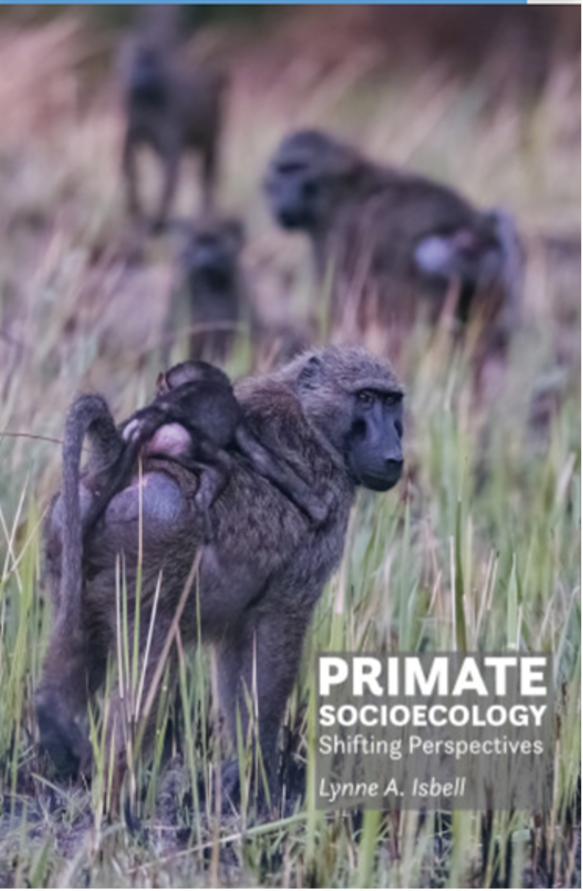
A new book by ABS member Lynne Isbell is challenging old assumptions. Primate Socioecology: Shifting Perspectives (Johns Hopkins University Press, 2024) offers a new way of understanding the diversity of primate social organizations by offering alternatives to three long-standing views. First, Isbell argues that the commonly used descriptive classification system of primate social organizations based on numbers of adult males and females living together is unsatisfactory. She then offers a functional alternative based on the variable ability of adult females to control their home range boundaries and share their home ranges with other females, leading to the identification of seven types of social organizations. Second, although Isbell’s research has long focused on the effects of predation on primates, she challenges the predominant view that predation pressure favored group-living in diurnal primates and solitary foraging in nocturnal primates with a new argument that combines foraging efficiency with sensory adaptations. Finally, she also challenges the predominant view that predation favored nocturnality in small primates and diurnality in large primates by arguing that this dichotomy is better explained by thermal constraints. By offering new ways to look at old ideas, Isbell’s book does much to reinvigorate socioecological theory.
“A persuasive call to rethink traditional explanations for species differences in sociality. Isbell's theory is explicit, richly supported, and thoroughly constructive. I expect this frank, creative discussion to inspire primatologists for decades.” – Richard Wrangham, Harvard University
“A must read for anyone interested in the history and development of theoretical primate behavioral ecology.” – Thomas Struhsaker, Duke University
SPECIAL ISSUES OF INTEREST IN PHIL TRANS
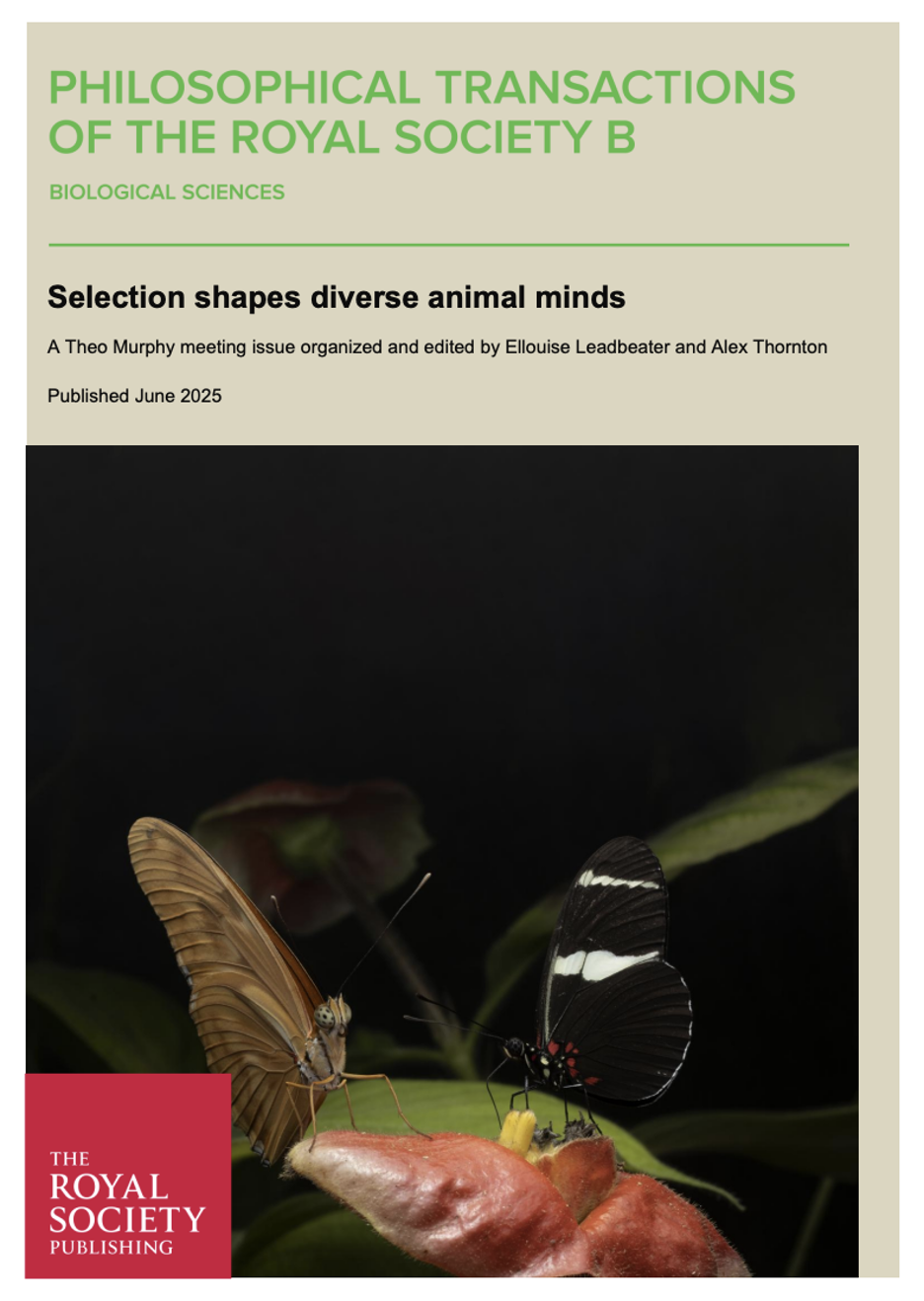
Royal Society Publishing has recently published a special Theo Murphy Meeting issue of Philosophical Transactions B entitled Selection shapes diverse animal minds organised and edited by Ellouise Leadbeater and Alex Thornton and the articles can be accessed directly at www.bit.ly/PTB1929
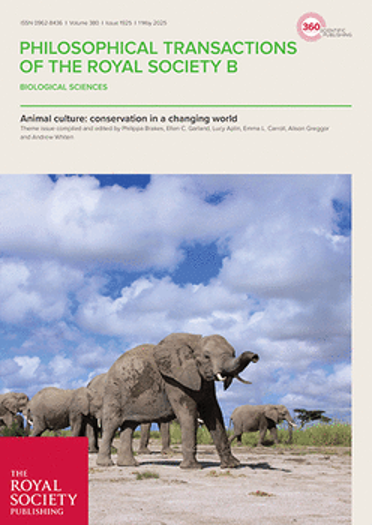 The following issue from Royal Society Publishing Philosophical Transactions B is now highly cited and widely read: Animal culture: conservation in a changing world compiled and edited by Philippa Brakes, Lucy Aplin, Emma L Carroll, Alison L Greggor, Andrew Whiten and Ellen C Garland and the articles can be accessed directly at www.bit.ly/PTB1925 .
A print version is also available at the special price of £40.00 per issue from [email protected] .
The following issue from Royal Society Publishing Philosophical Transactions B is now highly cited and widely read: Animal culture: conservation in a changing world compiled and edited by Philippa Brakes, Lucy Aplin, Emma L Carroll, Alison L Greggor, Andrew Whiten and Ellen C Garland and the articles can be accessed directly at www.bit.ly/PTB1925 .
A print version is also available at the special price of £40.00 per issue from [email protected] .
ANNOUNCING THE COLLABORATIVE FOR ANIMAL BEHAVIOR (CoLAB) at UNIVERSITY OF TENNESSEE
We live in a time of unprecedented environmental change. Rising noise and light pollution interfere with signals and time-cues, escalating temperatures alter cognition, health, and survival, and emerging pathogens reshape social and ecological interactions. Understanding how animals perceive and behaviorally respond to these challenges is essential as the Anthropocene transforms the environments animals inhabit.
The Collaborative for Animal Behavior (CoLAB) at the University of Tennessee, Knoxville brings together faculty across evolutionary biology, psychology, neuroscience, veterinary medicine, animal science, and more to address this foundational challenge. Our mission is to understand how animals collectively construct their perception and behaviorally respond to a changing world by advancing fundamental research in animal behavior.
CoLAB is also a growing hub for training the next generation of behavioral biologists. Multiple faculty across departments are recruiting graduate students in behavior, and UTK now offers a new undergraduate major in Animal Behavior -making Knoxville an exciting place to study behavior at every career stage.
Learn more at colab.utk.edu!
CITIZEN SCIENCE PROJECT: BAFFLING IN TREE CRICKETS
Singing insects need to advertise their songs across long distances. But did you know that some of them build their own megaphones? Tree crickets often use leaves as tools to amplify their songs - a phenomenon called "baffling" - and increase their chances of mating. There are multiple baffling strategies, but perhaps the most advanced and efficient one is calling from self-made holes in the leaves.
I am Ashlesh Pattanaik, a PhD student at the University of Tennessee, Knoxville. With a little bit of phylogenetics and a little bit of citizen science, I am interested in understanding the origin and evolution of this unique behaviour. To document the different baffling strategies in 20+ tree cricket species across the US, I have created an iNaturalist project, the details of which can be found here: https://www.inaturalist.org/projects/baffling-in-north-american-tree-crickets.
If you are a nocturnal field enthusiast, please keep an ear out for some baffling tree crickets on shrubs, grasses, and of course, trees. Every single observation will be a big contribution to this project! Although the project says North American/US tree crickets, global observations are welcome. And do spread the word!
If you have any questions or concerns, please send them my way: a>[email protected]. Stay baffled!
GRADUATE STUDENT POSITION AT U KENTUCKY
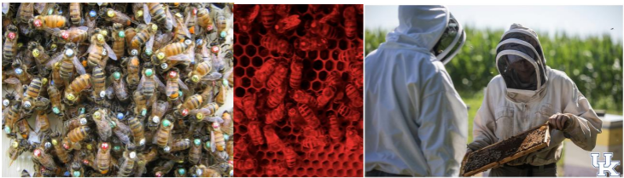
Dr. Michael Tackenberg and Dr. Claire Rittschof are recruiting a PhD student for a collaborative project involving honey bee circadian biology and behavioral neuroscience at the University of Kentucky. The candidate will matriculate through the Department of Biology and participate in a recently funded project investigating how the honey bee nervous system integrates combinations of day length and temperature cues to regulate visual sensitivity and activity patterns in changing environments. A competitive candidate will have some background in molecular biology, neuroscience, and/or animal behavior, as well as strong quantitative skills and interests. Participation in field activities will be required, but no experience working with insects and/or honey bees is necessary.
More details can be found here: https://clarerittschof.com/news-and-announcements/
Please contact [email protected] and [email protected] to discuss your interest.