CONTRIBUTE TO THE SOCIETY AND RUN FOR A LEADERSHIP POSITION!
The Animal Behavior Society invites nominations for several leadership positions to be filled this year: Second President-Elect, Member-at-Large, Program Officer, and Student Representative. These roles are central to guiding the Society's activities and sustaining a vibrant, inclusive ABS community. Self-nominations are warmly encouraged. The slate of nominees will be presented at the summer conference, with voting to take place the following spring. Please send nominations to [email protected] (Nominations Committee Chair: Emily DuVal).
WELCOME TO OUR NEW EDITORS!
The ABS Editorial Team is pleased to announce the appointment of five new associate editors beginning 1 January 2026, a new Reviews Editor who is slated to begin 1 May 2026, and our new assistant managing editor. We are elated to be moving into the new year with such a stellar editorial team!
Their names, institutional affiliations, emails, and links to their websites follow:
New Associate Editors
- Maria Albo, Universidad de la Republica, Uruguay, website: https://explorers.nationalgeographic.org/directory/maria-j-albo, email: [email protected]
- E. Keith Bowers, University of Memphis, website: https://ekbowers.com/, email: [email protected]
- Gloriana Chaverri, Universidad de Costa Rica, website: https://www.batcr.com/, email: [email protected]
- Norman Lee, St. Olaf College, website: https://pages.stolaf.edu/leelab/, email: [email protected]
- Jennifer Snekser, Canisius University, website: https://www.canisius.edu/academics/our-schools/school-natural-environmental-animal-sciences/faculty-and-staff/jennifer, email: [email protected]
- Clint Kelly, Universite du Quebec a Montreal, website: https://kellylab.weebly.com/, email: [email protected]
- Lynna Kiere, email: [email protected]
NOW HIRING: POSITIONS IN ANIMAL BEHAVIOR
Looking for your next opportunity in animal behavior? A variety of academic and research positions are currently available.
Visit the Animal Behavior Society job listings page to explore openings and learn more:
https://www.animalbehaviorsociety.org/web/news.php.
If you have a job to post, follow the link in the upper right of that page to share the information.
1-YEAR VISITING ASSISTANT PROFESSOR POSITION
The University of Puget Sound Biology Department is hiring a 1-year Visiting Assistant Professor to teach Introductory Biology (lecture and labs) both semesters plus a lab section of a 200-level Genetics course. The Intro class typically has an enrollment of 42 students with 3 lab sections of 14 students. The instructor will be teaching 1 out of 2-3 concurrent sections of BIOL 111 and will have the opportunity to work collaboratively with other instructors to coordinate these sections and their labs. All labs have pre-written manuals that can be adjusted as required, or used as-is. Lab space and modest funds are available to engage in research with students, though there is no expectation of this for a 1-year position. Please see more here.
NEW BOOK FROM ONE OF OUR MEMBERS
When we think of animals that provide the greatest insights into animal cognition and behavior, primates and honeybees come to mind, or perhaps whales or octopus. What about the raccoons that plunder our rubbish at night, or the coyotes that threaten pets and livestock, or the gulls that divebomb for snacks at the beach? Outsider Animals challenges everything you thought you knew about the overlooked animals that live in proximity to humans, sharing the stories that each has to tell about adaptation and cohabitation on our increasingly crowded planet.
Marlene Zuk gives us a new appreciation for the animals we often shun, explaining why these unpopular creatures have something special to teach us not only about the ways we deal with other species but about our own place in nature and what it means for an animal to belong somewhere. Read more or pre-order it here.
FREE! GRAPHIC NOVEL ON ANIMAL BEHAVIOR
Understanding Animal Behaviour is a graphic novel, FREE, and your alternative to a dry, expensive textbook. It provides an accessible, authoritative overview of the essentials of animal behavior. It illustrates how behavioral research is done, while showcasing the diverse scientists doing that research. Use it for undergraduate teaching or as a graduate reading for a refresher on all things animal behavior. The entire book is now available as a FREE pdf download, or mix and match individual standalone chapters to suit your needs.
Get your free copy and other free education resources here:
ordlab.unsw.edu.au/understanding-animal-behaviour
Topics covered in the graphic novel:
Preface: How Evolution Works
Ch1: Science of Behaviour
Ch2: Neuroethology
Ch3: Learning & Cognition
Ch4: Communication
Ch5: Finding A Mate
Ch6: Conflict
Ch7: Social Behaviour
Ch8: Finding A Home
Ch9: Finding Food
Ch10: Origins of Behaviour
Epilogue: Natural Queer
Researchers featured in the graphic novel:
Dan Blumstein, Nora Campbell, Barbara Clucas, Sasha Dall, Indraneil Das, Elisabeth Derryberry, Renee Duckworth, Matt Fuxjager, Rosemary Grant, Peter Grant, Andrea Griffin, Daniel Hooper, Annie Leonard, Jonathan Losos, Karen Mabry, Lisa Mangiamele, Emilia Martins, Mariana Mayer Pinto, Courtney Morgans, Dan Noble, Gail Patricelli, Noa Pinter-Wollman, Doris Preininger, Judy Stamps, Marlee Tucker, Rudiger Wehner, Stacey Weiss, Jessica Yorzinski and Lindsay Young
NEW ANIMAL BEHAVIOR MAJOR AT THE UNIVERSITY OF TENNESSEE, KNOXVILLE
The University of Tennessee, Knoxville has launched a new Animal Behavior major, an interdisciplinary undergraduate program designed to train the next generation of animal behaviorists at a research-intensive (R1) institution. The major brings together faculty and coursework spanning Ecology & Evolutionary Biology, Psychology and Neuroscience, Animal Science, Philosophy, Earth Environmental and Planetary Sciences, Veterinary Medicine, and Natural Resources.
The curriculum provides a strong foundation in core animal behavior concepts-communication, learning, social behavior, and experimental design-paired with hands-on laboratory and field experiences. Students then complete coursework across three advanced training areas: (1) Causes of Behavior (neurobiology, physiology, perception), (2) Evolution of Behavior (behavioral ecology, evolutionary history), and (3) Applied Approaches (animal welfare, conservation, and human-animal interactions). A distinctive feature of the program is its integration of ethical, historical, and cultural perspectives on animals, encouraging students to think broadly about how behavior research informs real-world challenges.
The major is anchored by the Collaborative for Animal Behavior (CoLAB), a campus-wide research community that connects students with active research programs spanning wildlife conservation, animal communication, social behavior, behavioral neuroscience, and animal welfare. Students gain early research experience, participate in seminars and workshops, and can pursue internships with zoos, conservation organizations, veterinary clinics, wildlife rehabilitation centers, and animal care facilities.
The Animal Behavior major is now open to students as a BS degree.
Interim Program Director: Todd Freeberg ([email protected])
Program Director (2026-2027): Alejandro Velez Melendez ([email protected])
Learn more about the program and curriculum here:
https://artsci.utk.edu/academics/programs/cosci/animal-behavior/
SPECIAL ISSUE OF INTEREST?
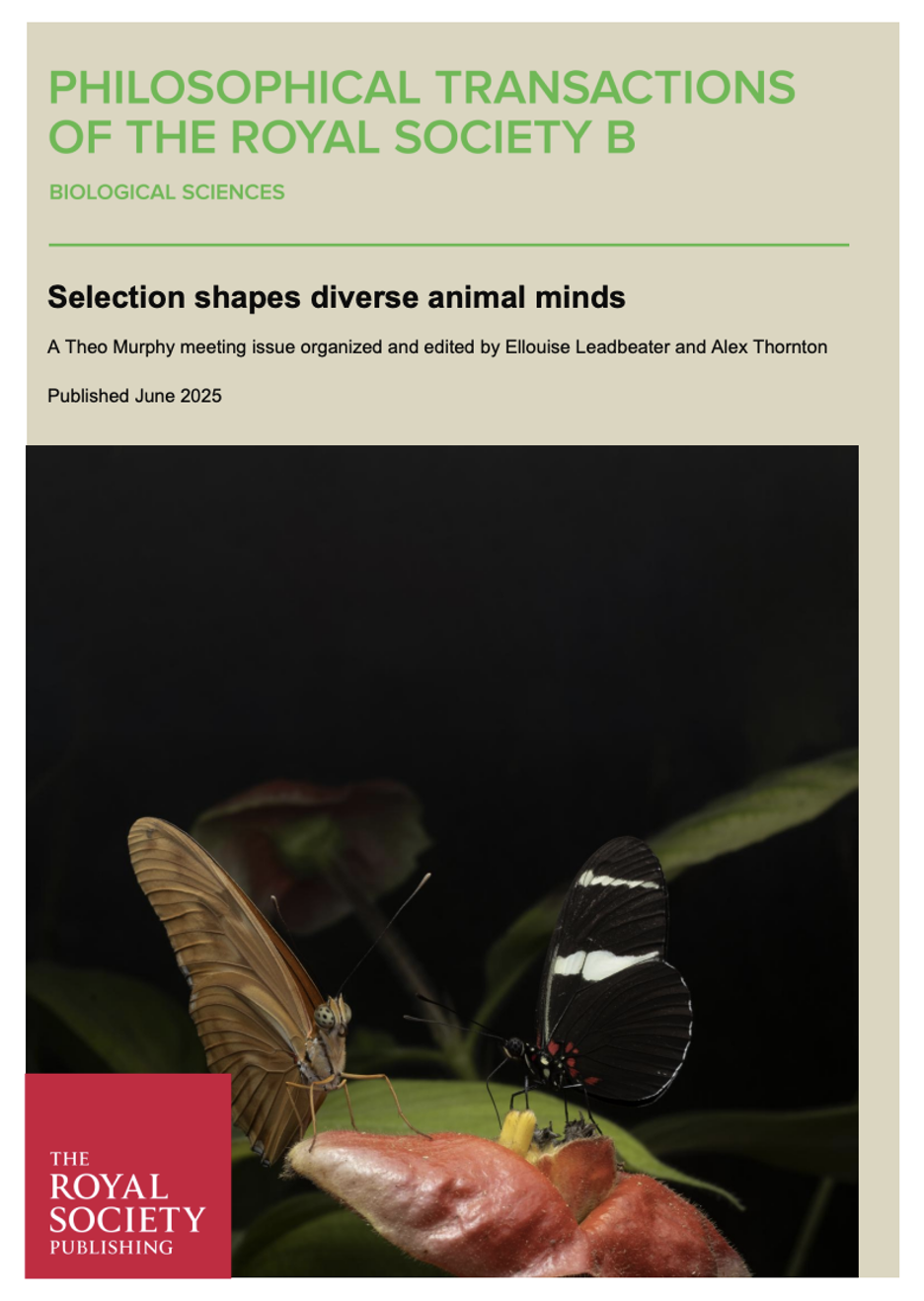
The following issue from Royal Society Publishing is one of our most highly cited and widely ready issues - Theo Murphy Meeting issue of Philosophical Transactions B entitled Selection shapes diverse animal minds organized and edited by Ellouise Leadbeater and Alex Thornton and the articles can be accessed directly at www.bit.ly/PTB1929
A print version is also available at the special price of £40.00 per issue from [email protected]