
ABS Historian, Sue Margulis
A History of ABS Historians
The Animal Behavior Society was formally established in 1964; since that time, the Society has had some 60 presidents…and only six historians! Why not learn a little bit about the ABS historians? The Society Historian is a non-voting member of the Executive Committee, and unlike other EC positions, which are elected, the Historian is appointed. What does it take to become the historian? Well of course, some “history” with the Society is critical – years of membership, participation, and so on. And while all past historians have served many roles in the Society – from committee chairs to president – this is by no means a pre-requisite.
In 1946, a Committee on the Study of Animal Societies Under Natural Conditions (CSASNC) was established at a conference at Jackson Memorial Laboratory on Genetics and Social Behavior. Shortly thereafter, in 1948, the Conference on Methodology and Techniques for the Study of Animal Behavior, organized jointly by the New York Academy of Sciences and the New York Zoological Society, brought together notable early animal behaviorists for a two-day conference. One of the invited presenters was A.M. Guhl. Interestingly, I find no indication of his name on the conference program, nor the proceedings, which were published in 1950.
For 15 years, CSASNC met in conjunction with other societies – AAAS, the Ecological Society of America, the American Society of Zoologists. By 1965, it was clear that the need, interest, and motivation to establish an independent society existed, and ABS was born. The firs president was E.B. Hale, and the first historian was A.M. Guhl. Although Guhl isn’t formally listed as the historian until 1970 – when the position was established – it is clear that he served as the keeper of the society’s early history for many years prior. He is also the only one of only two of the historians to be credited as a Founder of the Society.
Guhl is best known for his research on poultry, blending together behavior, genetics, and environment in his research on social aspects of poultry mating behavior and dominance. He worked closely with the next historian to ensure that the early history of the society was safely and permanently maintained.
In 1974, founder Martin Schein assumed the responsibilities of ABS Historian – a position he held for 14 years. Schein’s research focused on social and sexual behavior, primarily in domesticated species including turkeys and rats. Early during his tenure as historian, he and AM Guhl worked together to publish a valuable monograph on the early history of the Society. It was a very impressive compilation of the people, activities, and actions during these early years of the Society.
As the Society matured, the number of living founders of course declined. The last living founder, Wesley Lanyon, passed away in 2017. Other prominent Society members emerged to take up the reigns of both Society leadership, and historical maintenance.
The first historian who was not also a founder was Don Dewsbury. Dewsbury held this position for an impressive 19 years, and he and his successor, Lee Drickamer, did the lion’s share of populating the ABS archive at the Smithsonian. Dewsbury was a comparative psychologist who focused on reproductive and social behavior in rodents, and was also a noted historian of psychology – perhaps drawing him to his role as Society historian. He edited a compilation of autobiographies of the founders of animal behavior in 1989. When the Society formally established a historical archive at the Smithsonian Institution in 1984, through the efforts of then-president Devra Kleiman, the task of populating that archive fell to Marty Schein and Don Dewsbury. Compiling (at that time) well over 20 years of material, at a time when all communication was via paper, was no trivial task. It took ten years, but an initial deposit of 78 archival boxes was made to the archive in 1995. Additional boxes were deposited in 1996, 1998, and 2006.
Following Don Dewsbury as historian was zoologist and animal behaviorist Lee Drickamer, who held this position for 8 years. Known for his work on proximate and ultimate aspects of behavior (primarily in rodents), Drickamer also wrote noted textbooks in animal behavior, and with Don Dewsbury as co-editor, published Leaders in Animal Behavior: The Second Generation (2009). During this time, the transition to digital records was moving forward rapidly. Consequently, deposits to the archive effectively ended. Nonetheless, the historian still endeavored to ensure that all Society documentation was stored in some fashion. The historian took on a more substantive role in preparing “in memoriam” contributions for the Newsletter.
Zuleyma Tang-Martinez became the Society historian in 2015. Her broad research interests span proximate and ultimate explanations of behavior and test long-held paradigms. She continued the work of her predecessor to ensure thoughtful maintenance of materials and recognition of notable animal behaviorists who may have passed. Tang-Martinez has a long history with the Society and will mark her 50th consecutive ABS meeting in 2026 – an impressive feat.
After serving as historian for 8 years, Zuleyma passed the responsibility on to me. Like the other historians, I have a keen interest in history of science and have made ABS my professional home throughout my career. I decided to explore the archive and learned that we can in fact digitally archive materials there. Why do this, if everything is archived digitally anyway? The Smithsonian archive is searchable and accessible and will (in theory) be maintained in perpetuity. I have been working to fill the gaps, particularly between the time of the last archival deposit – in 2006 – and the centralized archiving of conference programs, annual reports, newsletters, and so on – around 2015. Fortunately, I did not miss any conferences during that time, so programs are available. I will continue to work to fill the gaps during my tenure in this role. And, in a few years’ time, ABS will be looking for its next historian…
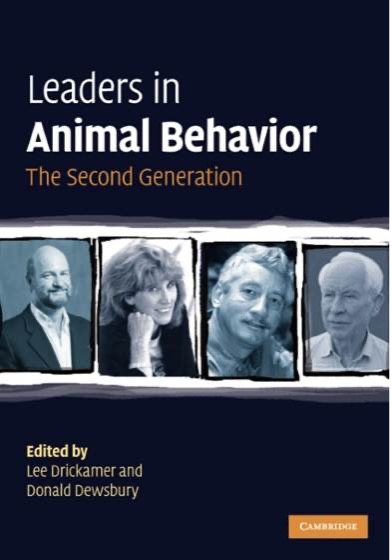
Publications by the historians, and about the history of our field and Society.
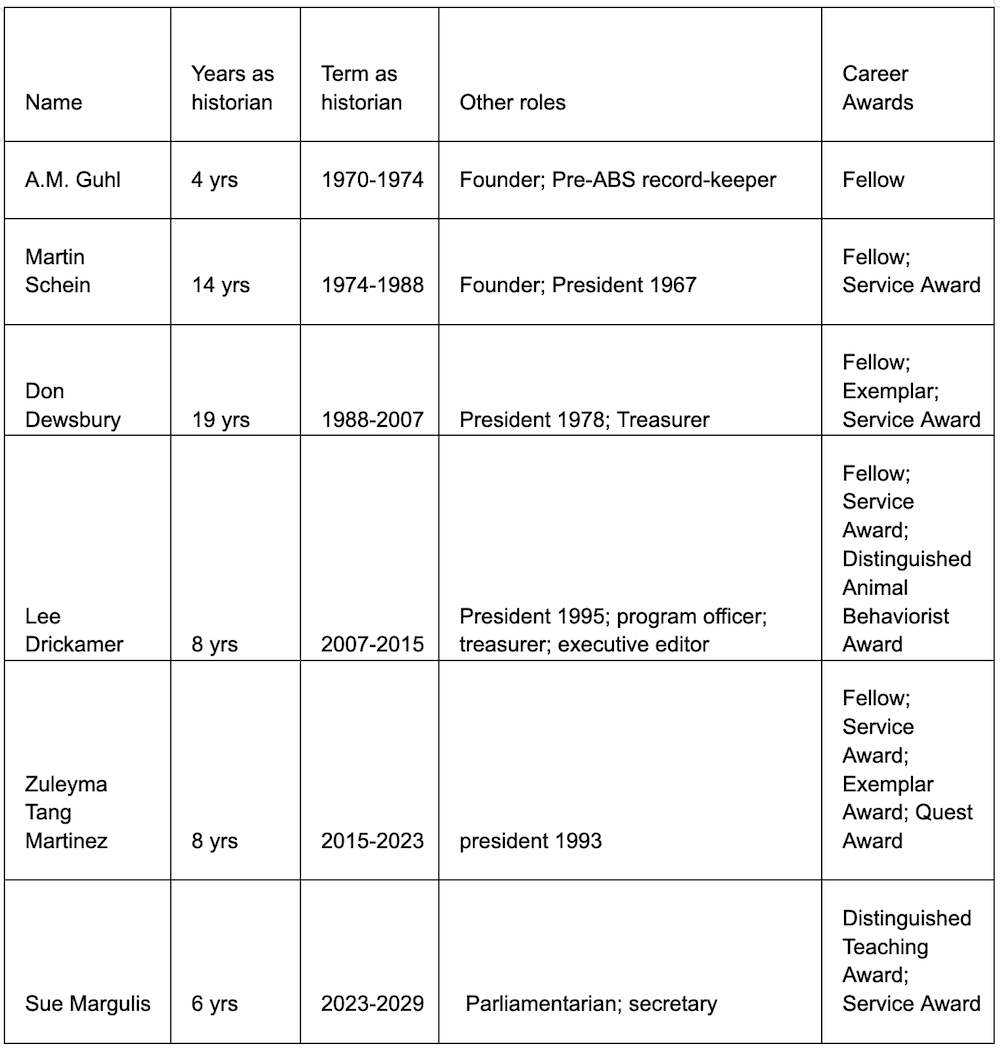
Overview of the Historians of the Animal Behavior Society
Publications of interest (listed chronologically)
Annals of the New York Academy of Sciences, 1950. Methodology and techniques for the study of animal societies. 51(6): 1003-1122.
Guhl, A.M., and Schein, M. W. 1976. The Animal Behavior Society: Its Early History and Activities.
Dewsbury, D. (ed). 1989. Studying Animal Behavior: Autobiographies of the Founders. University of Chicago Press.
Drickamer, L., and Dewsbury, D. (eds). 2009. Leaders in Animal Behavior: the Second Generation. Cambridge University Press.