In Memorium:
Roy L Caldwell
1943-2025
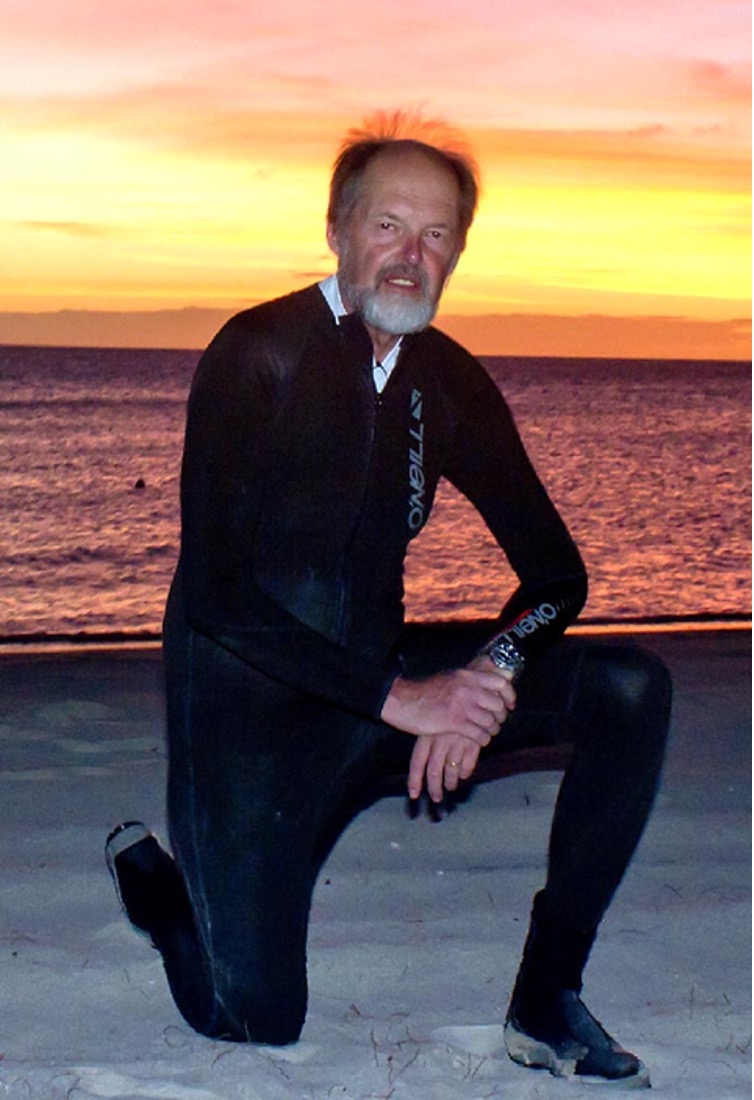
Photo credit: Michael Bok
Contributed by Tom Cronin
Roy L. Caldwell passed away on December 16, 2025 at the age of 82. He is survived by his wife, Gloria, and his two children, Erica and Michael.
A long-time member of the Animal Behavior Society, Roy is best known for his extensive studies of the behavioral ecology of tropical marine invertebrates. So, for some it might be surprising to learn that he was born, raised, and educated in Iowa, about as far from the ocean as one can imagine. He did his undergraduate and graduate education at the University of Iowa, completing his doctoral dissertation in 1969 under the direction of Hugh Dingle. Although his doctoral work concerned the life cycles of milkweed bugs, field trips during his time as a graduate student took him to Belize and Bermuda, where he encountered the strange crustaceans known as mantis shrimps, or stomatopods. Clearly, he was charmed by them. He published his first paper on these animals even before he finished graduate school, and in 1976 he published the first comprehensive popular account of their biology in Scientific American – an article that piqued my own interest in the stomatopods and eventually led to a collaboration with Roy that lasted some 40 years, including literally hundreds of hours together underwater.
In 1970, after a year as a postdoc in London, at the Imperial College of Science and Technology, Roy was hired as an assistant professor at the University of California, Berkeley. He remained there for the rest of his professional career. While at Berkeley he had several administrative positions: Director of the Field Station for Behavioral Research, Chair of the Department of Integrative Biology, and Director of the University of California Museum of Paleontology.
Though best known for his work with stomatopods, Roy was also fascinated by octopods, and published several papers on their behavioral ecology and general biology. His research occurred primarily in tropical reef habitats, mainly in Australia, French Polynesia, and Indonesia; but he was also spotted in numerous locations throughout the Caribbean as well as in the chilly waters of California’s Bay Islands.
My first encounter with Roy occurred at a meeting on stomatopod biology in Trieste, Italy in 1985, just after I myself had begun working on stomatopod vision. Roy’s talk was called “Living With the Bomb”, and was delivered just after a lengthy, wine-laden Italian lunch – making it perhaps a bit more entertaining than Roy intended. The point of the talk was that much of stomatopod anatomy, ecology, and behavior is driven by their explosively powerful raptorial punches. I thought that their visual physiology also reflected this effect, and we began to collaborate on studies of these animals’ sensory physiology, color appearance, and behavior. It was an honor for me, a new assistant professor, to be working with the pre-eminent researcher in the field. We made our first field trip together to Lizard Island on the Great Barrier Reef in 1991, where we were joined by Justin Marshall, who had recently completed his PhD at Sussex University. The three of us worked together on dozens of field trips and also completed two 10-day submerged expeditions in the Aquarius underwater laboratory in the Florida Keys. Working from an underwater habitat with elevated atmospheric pressure is called “saturation diving”. In Roy’s last communication to me, when I retired in August 2025, he wrote that I was “the one person with whom I’d like to saturate.”
Roy was the consummate field biologist. On arriving at a field station, he would grab his gear and immediately head off to the reef to collect animals. Every stomatopod we collected over 24 field trips to Lizard Island was catalogued for species, size, and sex – a final inventory of thousands of individuals. He knew how to spot animals in the challenging reef environment and how to tease them into our collecting bottles, drawing from a bucketload of original pieces of equipment. We called Roy “the human stomatopod” for his ability to predict their location and behavior. His vast knowledge of these animals led us to focus on a small zoo of species appropriate for studying specific hypotheses related to visual ecology and physiology.
Roy’s research career led to many discoveries, including such highlights as polarized-light signaling in stomatopods, the use of deception in stomatopod signaling, locomotion by somersaulting or rolling like a wheel in some species, and in molluscs, flashy signals produced by the disco clam. Naturally his publication record is vast, and beyond reaching scientists, he was active in aquarium clubs, wrote for a children’s encyclopedia, and was involved in the making of numerous wildlife films by the BBC, Discovery Channel, and National Geographic.
I’ll forever remember our late evenings with a glass of wine on the lanai of the field dormitory in Australia, talking science and pretty much everything else. And I’ll also recall the ritual sunsets with a beer on the beach, trying to spot the elusive green flash. Roy’s life impacted many of us, and we all will miss him terribly.